
Specialized Pipe Tees & Equal/Reducing Fittings
High-integrity steel tees engineered specifically for Japan’s power generation, chemical plant engineering, and LNG terminal infrastructure.
1. Japan’s Industrial Landscape & Pipeline Infrastructure Demands
Japan’s industrial sector represents one of the most technologically advanced, safety-critical, and highly regulated manufacturing environments in the world. As the nation accelerates its Green Transformation (GX) initiative, the demand for ultra-reliable, high-pressure pipeline components—specifically butt-welding pipe tees, equal tees, and reducing tees—has evolved dramatically. From major industrial clusters along the Keihin and Hanshin industrial belts to emerging semiconductor hubs in Kyushu (the "Silicon Island") and Hokkaido, engineering firms require piping hardware that strictly conforms to Japanese Industrial Standards (JIS) while adhering to strict environmental and thermal cycle fatigue limits.
The operational landscape in Japan presents unique environmental and regulatory challenges for pipe tee suppliers:
- Seismic Resilience Requirements: Pipeline networks in Japan must endure severe seismic acceleration. Piping tees must possess superior yield-to-tensile ratio, flawless weld integrity, and uniform wall thickness to prevent failure during high-frequency micro-vibrations and severe earthquakes.
- High-Pressure Gas Safety Act (KHK Compliance): Facilities operating liquefied natural gas (LNG) terminals, ammonia co-firing power units, and hydrogen delivery channels are governed by METI (Ministry of Economy, Trade and Industry) rules, mandating 100% volumetric non-destructive testing (NDT) on critical pressure-retaining components.
- Thermal Cycling Endurance: Japan’s expanding LNG import terminals (such as Tokyo Bay, Niigata, and Mizushima) require carbon steel and austenitic stainless steel tees capable of maintaining structural ductility at cryogenic temperatures down to -196°C.
Strict Quality Audits
Complete traceability from raw billet to final hydrostatic testing, supported by ISO 9001 quality systems and EN 10204 3.1/3.2 inspection certificates.
Hydrogen & Ammonia Ready
Ultra-clean inner surface finishing and specialized alloy formulations (WP91, Duplex S31803) designed to resist hydrogen embrittlement.
JIS & ASME Dual Certification
Seamless cross-walk manufacturing capabilities allowing components to satisfy both JIS B2311/B2312/B2313 and ASME B16.9 simultaneously.
2. Standard Compliance Cross-Walk: JIS vs. International Standards
To assist Japanese EPC engineering leads, plant asset managers, and global procurement buyers in selecting correct replacement parts and project specifications, the following matrix outlines material, dimensional, and testing cross-walks between international ASME standards and local JIS requirements utilized in Japanese industrial projects.
| JIS Standard (Japan) | ASME / ASTM Equivalent | Material Grade Options | Target Japanese Industry Sector | NDT & Quality Gate Requirements |
|---|---|---|---|---|
| JIS B2311 (Piping fittings for general use) | ASME B16.9 / ASTM A234 WPB | SGP, FSGP, Carbon Steel (WPB/WPC) | Commercial HVAC, District Heating, Water Networks | Visual Inspection, Dimensional Check, Hydrostatic Test |
| JIS B2312 (Steel butt-welding pipe fittings for pressure use) | ASME B16.9 / ASTM A234 WP11, WP22, WP91 | STPT 370/410, Alloy Steel (WP91, 15CrMo) | Thermal Power Generation, High-Pressure Steam Lines | 100% Ultrasonic (UT), Magnetic Particle (MT), PMI Verification |
| JIS B2313 (Steel plate butt-welding pipe fittings) | ASME B16.9 (Large Dia. Welded) | SUS304, SUS316L, SUS317L, Duplex S31803 | LNG Receiving Terminals, Off-shore Modular Skids | 100% Radiographic Testing (RT), Dye Penetrant (PT) |
| JIS B2316 (Steel socket-welding pipe fittings) | ASME B16.11 (Forged Fittings) | A105, Stainless Steel 304/316 | Semiconductor Pure Water & Chemical Lines | High Precision Machining, Surface Roughness Ra < 0.4µm |
China Factory 4.0: Supply Chain Resilience & Cost Efficiency for Japanese Buyers
Hebei Cangrun Pipeline Equipment Co., Ltd. operates three major manufacturing plants across Cangzhou, Hebei—China's primary piping equipment manufacturing core. By leveraging automated cold/hot hydraulic Tee forming machines, modern heat treatment furnaces, and robotic beveling systems, we deliver extreme structural integrity with reduced production lead times.
For Japanese general contractors (JGC, Chiyoda, Mitsubishi Heavy Industries, Toyo Engineering), sourcing through Cangrun provides a strategically resilient dual-sourcing model that buffers against localized supply chain bottlenecks while offering up to 25-35% Total Cost of Ownership (TCO) savings.
- Automated Hydraulic Tee Cold/Hot Forming: Guarantees uniform grain refinement and consistent neck height across large-diameter tees up to DN1900.
- Integrated Logistics Channel to Japan Ports: Fast shipping lines operating directly from Tianjin Port and Ningbo Port directly to Yokohama, Tokyo, Nagoya, Kobe, and Osaka within 3–5 days transit time.
- Zero-Defect Quality Assurance: Full Positive Material Identification (PMI), wall-thickness ultrasonic mapping, and 3D laser dimension scans prior to packaging.
Rapid Project Execution Protocol
Cross-checking Japanese engineering drawings against JIS/ASME tolerances within 24 hours.
Normalized, quenched, and tempered microstructural treatment for maximum fracture toughness.
Third-party inspection by SGS, TÜV, or Lloyd’s Register according to project quality plans.
Fumigated wooden cases, end-cap protection, and VCI anti-corrosion foil wraps for marine transit.
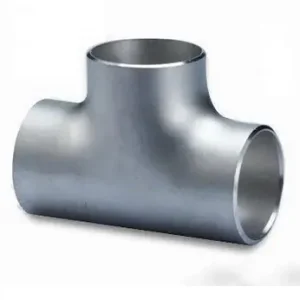
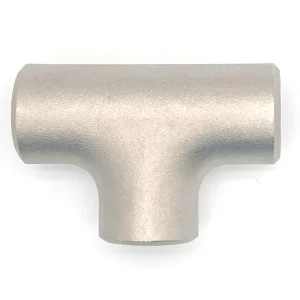
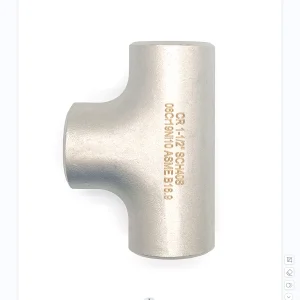
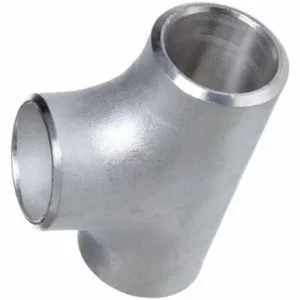
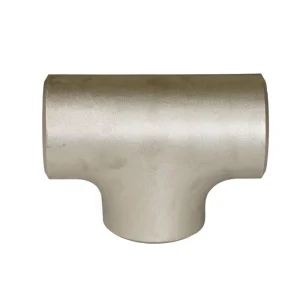
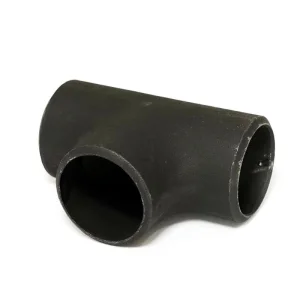
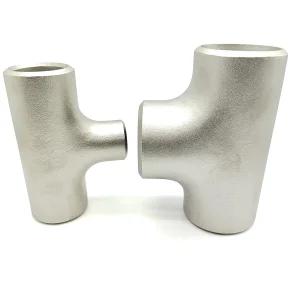
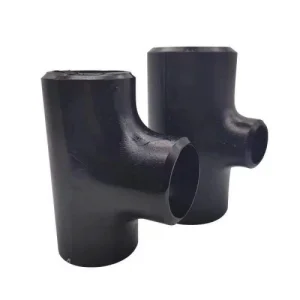
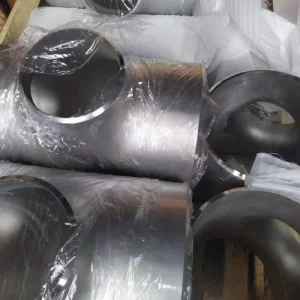
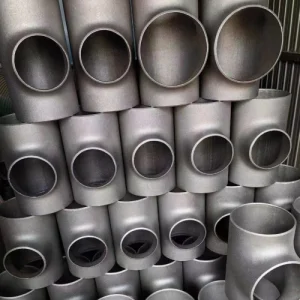
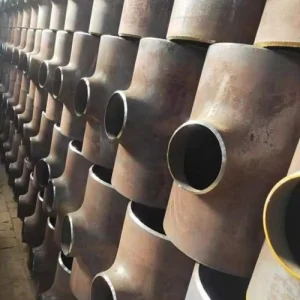
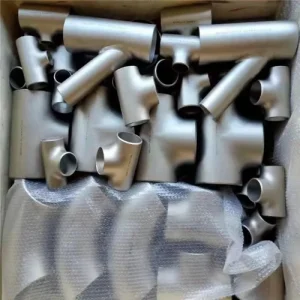
Industrial Butt-Weld Tees & Specialty Fittings
Comprehensive selection of carbon, alloy, duplex, and stainless steel pipe tees engineered for global and Japanese industrial applications.
Frequently Asked Questions for Japan Market Procurement
Expert technical insights answering key regulatory, material standard, and logistical questions for Japanese engineers and global buyers.
Can Cangrun provide Mill Test Certificates (MTC) compliant with EN 10204 3.1 / 3.2 for Japanese projects?
Yes. Every batch of pipe tees, elbows, reducers, and flanges exported to Japan is accompanied by an EN 10204 3.1 certificate detailing actual chemical composition, mechanical properties (yield strength, tensile strength, elongation, impact testing at sub-zero temperatures), microstructural grain size, and 100% NDT inspection results. Independent third-party inspection (EN 10204 3.2) by agencies such as SGS, TÜV, DNV, or Lloyd’s Register can also be arranged prior to shipment.
How do Cangrun’s pipe tees comply with Japan’s High Pressure Gas Safety Act (KHK standards)?
For applications subject to KHK regulations (such as high-pressure gas facilities, hydrogen refueling hubs, and power generation units), we supply seamless and welded tees fabricated with strict heat-treatment control, 100% volumetric X-ray Radiographic Testing (RT) or Ultrasonic Testing (UT), and verified non-destructive wall-thickness checks. We ensure material chemistry meets maximum carbon equivalent (CE) limits to guarantee crack-free field welding.
What size ranges and wall thicknesses are available for seamless and welded tees?
We manufacture seamless pipe tees from 1/2" up to 24" (DN15–DN600) and heavy-wall welded tees from 4" up to 78" (DN150–DN1900). Wall thickness capabilities range from light schedule SCH5S up to extreme SCH160 and XXS, with maximum wall thickness capability up to 150 mm.
What are the logistics and shipping lead times from Cangrun’s facilities to major ports in Japan?
Located near Cangzhou in Hebei, our factories have direct access to Tianjin Port and Ningbo Port. Direct ocean liner services connect directly to major Japanese coastal ports including Yokohama, Tokyo, Nagoya, Osaka, and Kobe. Ocean transit takes approximately 3 to 5 days, enabling total order-to-delivery turnarounds significantly faster than Western suppliers.
Can Cangrun manufacture custom reducing tees with non-standard branch ratios or wall schedules?
Absolutely. Utilizing 3D computer modeling and custom hot/cold hydraulic tooling, we manufacture custom reducing tees with non-standard run-to-branch diameter ratios, heavy-wall reinforcement branches, and custom bevel end preparations (such as compound bevels per ASME B16.25 or custom JIS groove geometries).
Ready to Secure High-Integrity Pipe Fittings for Your Japanese Project?
Connect with our technical engineering team to receive instant technical quotes, material datasheets, and complete JIS/ASME compliance documentation.
Send Inquiry Now