
High-Spec Pipe Fittings & Flanges for Indian Industrial Projects
Engineered for high-pressure fluid conveyance, extreme thermal shock compliance, and seamless integration with Indian Boiler Regulations (IBR) standards.
1. Executive Summary & Market Intent Analysis
India’s industrial sector is undergoing a monumental transformation. Propelled by macro-economic initiatives such as the PM Gati Shakti National Master Plan, Make in India 2.0, and massive capital investments into cross-country natural gas grids (such as the Urja Ganga Pipeline), demand for high-integrity pipeline infrastructure has surged to historic highs. Central to this infrastructure are specialized pipe bends—specifically long-radius induction bends (3D, 5D, 6D, 8D, and 10D)—which offer superior hydrodynamic efficiency, reduced pressure drops, and piggability compared to standard short-radius elbows.
Global and domestic EPC contractors (Engineering, Procurement, and Construction) operating in India face complex challenges: balancing rigorous metallurgical compliance under the Indian Boiler Regulations (IBR) and Bureau of Indian Standards (BIS) with tight project deadlines and fluctuating raw material costs. Sourcing high-quality bends requires deep technical collaboration between foreign export powerhouses—such as the advanced Cangzhou industrial piping cluster—and Indian engineering teams.
2. India's Industrial Landscape & Local Market Dynamics
Navigating the Indian market requires an understanding of its geographic industrial clusters. Sourcing strategies must account for distinct regional procurement centers and regulatory environments across India:
Western Hydrocarbon Corridor
Anchored by Gujarat (Jamnagar, Dahej, Hazira) and Maharashtra (Mumbai, Thane, Nagothane). Home to the world's largest refining complexes (Reliance Industries, IOCL Gujarat Refinery). High demand for ASTM A335 P91 alloy bends, duplex stainless steel bends, and Class 1500–2500 heavy flanges.
Eastern Metal & Power Belt
Spanning Odisha (Jharsuguda, Paradip), Chhattisgarh (Bhilai), and Jharkhand (Jamshedpur). Dominated by thermal power generation (NTPC), steel mills (SAIL, Tata Steel), and coal washeries requiring abrasion-resistant heavy-wall carbon steel (ASTM A234 WPB) and high-yield line pipe bends (API 5L X65/X70).
Southern Chemical & Marine Ports
Centering on Tamil Nadu (Chennai, Ennore), Andhra Pradesh (Visakhapatnam), and Kerala (Kochi). Driven by LNG receiving terminals, fertilizer complexes, and shipbuilding yards demanding corrosion-resistant ASTM A403 WP316L stainless steel bends and ASME B16.5 forged flanges.
Indian Infrastructure Mega-Drivers
India’s push to increase natural gas in its primary energy mix from 6.3% to 15% by 2030 has catalyzed the construction of over 33,000 km of cross-country gas pipelines. High-pressure transmission lines operated by GAIL, GSPL, and Pipeline Infrastructure Limited (PIL) mandate high-yield induction bends conforming to ASME B16.49 and API 5L X80 standards, featuring strict ovality and wall thinning parameters.
3. Global Procurement Demand & Cross-Border Sourcing Strategy
While domestic Indian pipe mills provide standard carbon steel fittings, global EPC contractors executing mega-projects in India frequently face domestic supply bottlenecks for large-diameter (≥24 inch), heavy-wall (SCH 120 to XXS), or specialized alloy induction bends. Importing from established manufacturing hubs like Cangzhou, Hebei, China provides critical strategic advantages:
| Evaluation Parameter | Domestic Indian Local Mills | Cangzhou Direct Export Hub | Strategic Advantage for EPCs |
|---|---|---|---|
| Large Diameter Bending (DN600–DN1400) | Limited capacity; high queue times | Multiple 1400mm Induction Benders | Lead time reduced by 35%–50% |
| Specialty Metallurgy (P91, Duplex, Inconel) | High raw material import lead times | Extensive billet & pipe stock inventory | Immediate thermal heat-treatment start |
| IBR Certification Compliance | Native compliance | Pre-inspected with Form III-C TPI support | Full regulatory safety compliance |
| Cost Efficiency (Landed Cost) | Higher overheads on custom non-standard radius | High-volume scale economics | 15% to 25% budget optimization |
To streamline customs clearance at major Indian ports like Nhava Sheva (JNPT), Mundra, and Hazira, international suppliers must provide complete documentation packages: Mill Test Certificates (MTC) conforming to EN 10204 3.1 or 3.2, NDT reports, heat treatment logs, and BIS/IBR approvals where applicable.
4. Macro Industry Engineering Solutions & Induction Bending Physics
Induction bending utilizes high-frequency electromagnetic induction coils to heat a narrow, circumferential band of the pipe wall while pushing the pipe forward at a controlled velocity. As the heated band moves through the coil, it is bent by a pivoting arm to the specified radius and immediately quenched with water or air forced cooling.
Wall Thinning & Extrados Compensation Formula
During bending, the outer radius (extrados) undergoes tensile elongation, resulting in wall thinning, while the inner radius (intrados) experiences compressive stress, leading to wall thickening. According to ASME B16.49 engineering guidelines, minimum design wall thickness ($t_{min}$) after bending is calculated via:
Where R is the bend radius and D is the outside diameter of the pipe. To ensure the final intrados/extrados complies with pressure design requirements, parent pipes are carefully selected with target wall over-tolerances prior to induction heating.
Manufacturing Capability Matrix
| Parameter | Induction Pipe Bends Standard | Cold Formed Elbows Standard |
|---|---|---|
| Applicable Standard | ASME B16.49, ISO 15590-1, EN 14870-1 | ASME B16.9, GB/T 12459, JIS B2311 |
| Bend Radius (R) | 3D, 5D, 6D, 8D, 10D, Custom up to 20D | 1.0D (Short Radius), 1.5D (Long Radius) |
| Nominal Diameter (DN) | DN50 – DN1400 (2" to 56") | DN15 – DN1200 (1/2" to 48") |
| Wall Thickness Range | 5.0 mm up to 120 mm (SCH 40 to XXS) | 2.0 mm up to 60 mm |
| Bending Angle Range | 1° to 180° (Custom degree precision ±0.2°) | 45°, 90°, 180° fixed angles |
| Post-Bend Heat Treatment | Normalizing, Tempering, Stress Relief, Solution Anneal | Factory Stress Relieved / Annealed |
Global Manufacturing Capabilities Serving Indian Industry
Quantifiable performance metrics that ensure seamless site installation, reduced field welding, and uncompromising structural integrity.
5. Indian Regulatory Compliance, IBR Standards & Quality Assurance
Deploying piping components in Indian industrial sites requires adherence to strict statutory safety frameworks. Failure to comply with domestic certification leads to port rejection or shutdown by Indian state boiler inspectors.
A. Indian Boiler Regulations (IBR 1950)
Any pipe bend or flange installed in high-pressure steam systems (operating at pressures exceeding 1.0 kg/cm² or temperatures above 225°C) must strictly comply with IBR guidelines. Imported piping components must be supplied with Form III-C Inspection Certificates, endorsed by an IBR-approved Independent Inspecting Authority (such as Lloyd's Register, BV, TUV, or DNV) prior to export shipping.
B. Bureau of Indian Standards (BIS) & Mandatory Quality Control Orders
The Ministry of Steel, Government of India, enforces mandatory BIS marking for carbon steel and alloy steel pipe fittings (under standards such as IS 1239 Part 2 and IS 3589). International factories supplying Indian buyers must hold valid BIS licenses or partner with certified exporters equipped to handle Third-Party Inspection (TPI) verification protocols.
C. Non-Destructive Testing (NDT) & Metallurgical Testing Protocols
Every induction bend undergoes comprehensive quality verification before clearance:
- Ultrasonic Testing (UT): 100% full-body wall thickness verification post-bending and flaw detection per ASTM A578 / ASME Sec V.
- Magnetic Particle Inspection (MPI): Surface crack testing along the intrados and extrados bent zones (ASTM E709).
- Hardness Testing: Ensuring post-bend heat treatment prevents localized embrittlement (Vickers / Rockwell hardness mapping).
- Ovality & Dimensional Checks: Guaranteeing out-of-roundness remains under 3% to facilitate seamless field fit-up and butt welding.
6. Technical Roadmap & Future Outlook (2025–2035)
As India accelerates its transition toward green energy and high-efficiency industrial processing, the technical requirements for piping systems are evolving rapidly:
Green Hydrogen & Ammonia Piping
India’s National Green Hydrogen Mission aims to produce 5 MMT of green hydrogen annually by 2030. Hydrogen conveyance requires specialized low-carbon alloy bends resistant to High-Temperature Hydrogen Attack (HTHA) and hydrogen embrittlement, demanding ultra-smooth internal surfaces and stringent NDT.
AI-Controlled Thermal Bending
Integration of real-time infrared pyrometry and closed-loop optical feedback controls during induction heating ensures temperature fluctuations remain within ±5°C. This prevents microstructural phase distortion in advanced grades like ASTM A335 P92 and Super Duplex UNS S32750.
CCUS & Ultra-Supercritical Power
Carbon Capture, Utilization, and Storage (CCUS) projects and 800MW Ultra-Supercritical thermal plants require heavy-wall pipe bends operating at steam temperatures exceeding 620°C and pressures over 30 MPa. Sourcing high-temper alloy bends (P91/P92) is paramount for structural endurance.
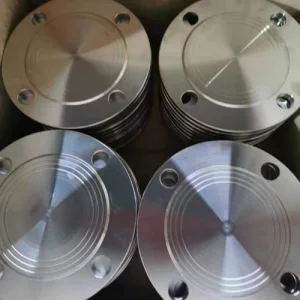
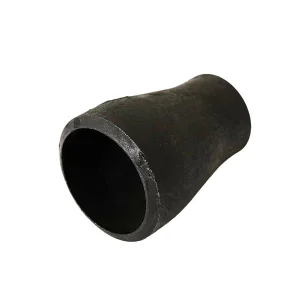
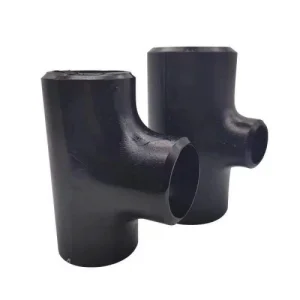
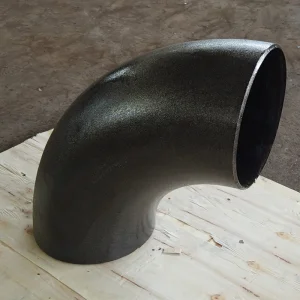
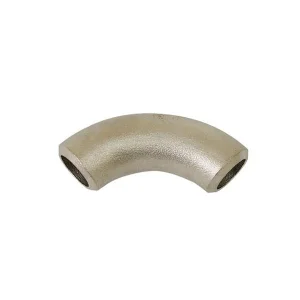
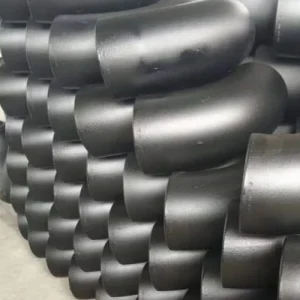
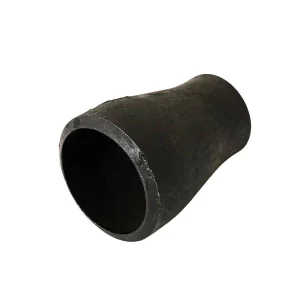
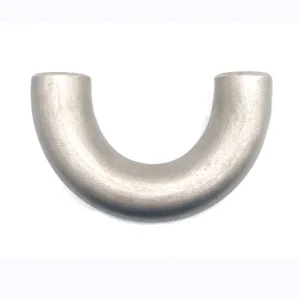
Industrial Fittings, Bends & Flanges Portfolio
Explore our full lineup of ASME, DIN, JIS, and EN standard pipeline equipment available for global direct-factory export to Indian ports.
Frequently Asked Questions (FAQ) - India Sourcing
Key engineering and logistics queries answered for EPC procurement leads and piping engineers importing bends into India.
What is the technical difference between ASME B16.9 elbows and ASME B16.49 induction bends?
ASME B16.9 covers factory-made wrought butt-welding fittings with fixed short and long radii (1.0D and 1.5D) manufactured via cold forming or mandrels. ASME B16.49 specifically governs factory-made carbon, low-alloy, and high-strength steel induction bends. Induction bends allow for customized radii (3D, 5D, 6D, 8D, 10D, up to 20D) and tailored angles (1° to 180°), minimizing fluid pressure drop and enabling pipeline piggability.
How do you ensure imported pipe bends comply with the Indian Boiler Regulations (IBR)?
For steam piping systems governed by IBR, we engage recognized Third-Party Inspection Agencies (such as Lloyd's Register, Bureau Veritas, or TUV) during production. Raw materials, heat treatment logs, and NDT reports are witnessed and certified on IBR Form III-C certificates, guaranteeing seamless acceptance by state boiler inspectors in India upon arrival.
What sea freight shipping routes and ports are used for deliveries to India?
Shipments originate from Tianjin or Qingdao ports, operating direct sea routes to major Indian maritime gateways: Nhava Sheva (JNPT, Maharashtra), Mundra (Gujarat), Hazira (Gujarat), and Chennai Port (Tamil Nadu). Average transit shipping time ranges between 14 to 20 days depending on vessel scheduling.
Can you supply custom tangent lengths on induction bends?
Yes. Unlike standard elbows which have minimal end dimensions, induction bends can be manufactured with extended straight tangents (e.g., 500mm, 1000mm, or custom project specifications) at both ends. This eliminates the need for extra circumferential field welds, reducing overall project installation cost and risk.
Which material grades are available for high-pressure refinery applications in India?
We supply a full spectrum of materials including ASTM A234 WPB/WPC, High-Yield line pipe steel ASTM A860 WPHY 52/60/65/70, Low-Temp steel ASTM A420 WPL6, Alloy steel ASTM A335 P11/P22/P91/P92, Stainless Steel ASTM A403 WP304L/316L/321/347, and Duplex/Super Duplex UNS S31803 / UNS S32750.
Ready to Source Bends & Fittings for Your Indian Project?
Get detailed engineering quotes, dimensional drawings, and material test reports from our export team within 24 hours.